

T.Loop at Dagens Industri AI & Datacenter Event
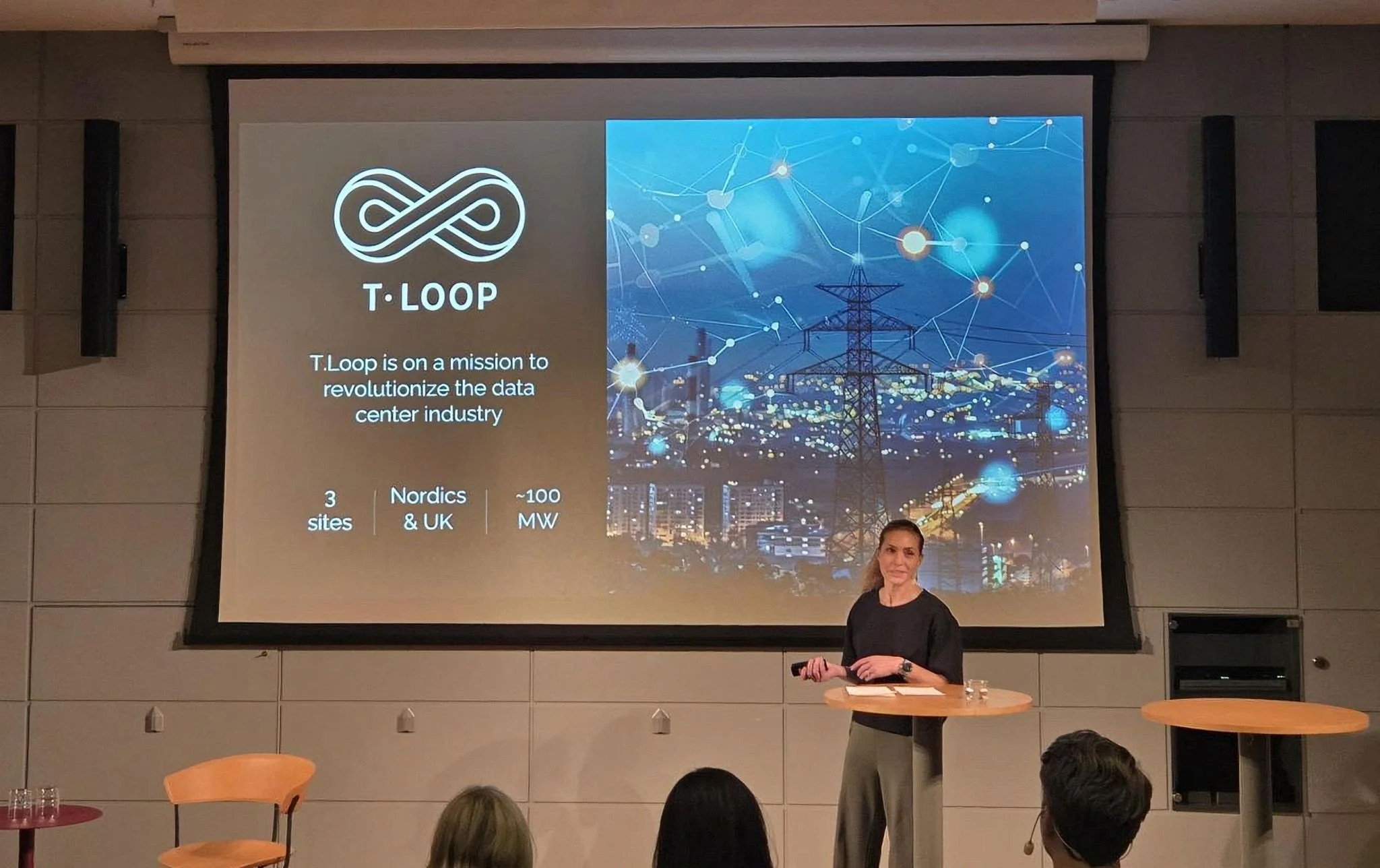
Turning AI load into an asset for the energy system
As one of the speakers at DI’s AI & Datacenter event, CEO Helena Fagraeus explained how AI inference is already redrawing the map for both data centers and the power grid. Computing capacity is around 100 GW globally and could triple within five years. That demands new ways to handle power — and to capture the heat that’s generated.
AI load requires new rules of the game
Large AI jobs can change consumption within milliseconds. When several sites ramp up or down at the same time, hundreds of megawatts can disappear or appear almost instantly. To protect frequency and voltage, the industry needs to control ramp rates, use battery buffers, and coordinate operations.
The heat production from the world’s data centers corresponds to the energy from up to 70 nuclear reactors. Today, much of it is cooled away. T.Loop instead wants to make the heat a schedulable product in district heating networks.
Energy Hubs close to the city
We see strong potential in local “Energy Hubs” where renewable electricity, energy storage, hydrogen, and flexible consumers are connected. The data center becomes the hub: it consumes electricity, delivers high-temperature heat to district heating, and offers ancillary services with batteries and backup capacity. Small-scale hubs in urban environments are entirely feasible — especially in the Nordics with their expanded district heating.
Data Energy Centers® — the ready-made component
T.Loop delivers facilities for high-density IT that provide steady, high-temperature heat to district heating and stabilize the power grid via batteries. To scale, new business models are required, and the IT and energy sectors must plan together. Our goal: don’t waste either compute or energy.